
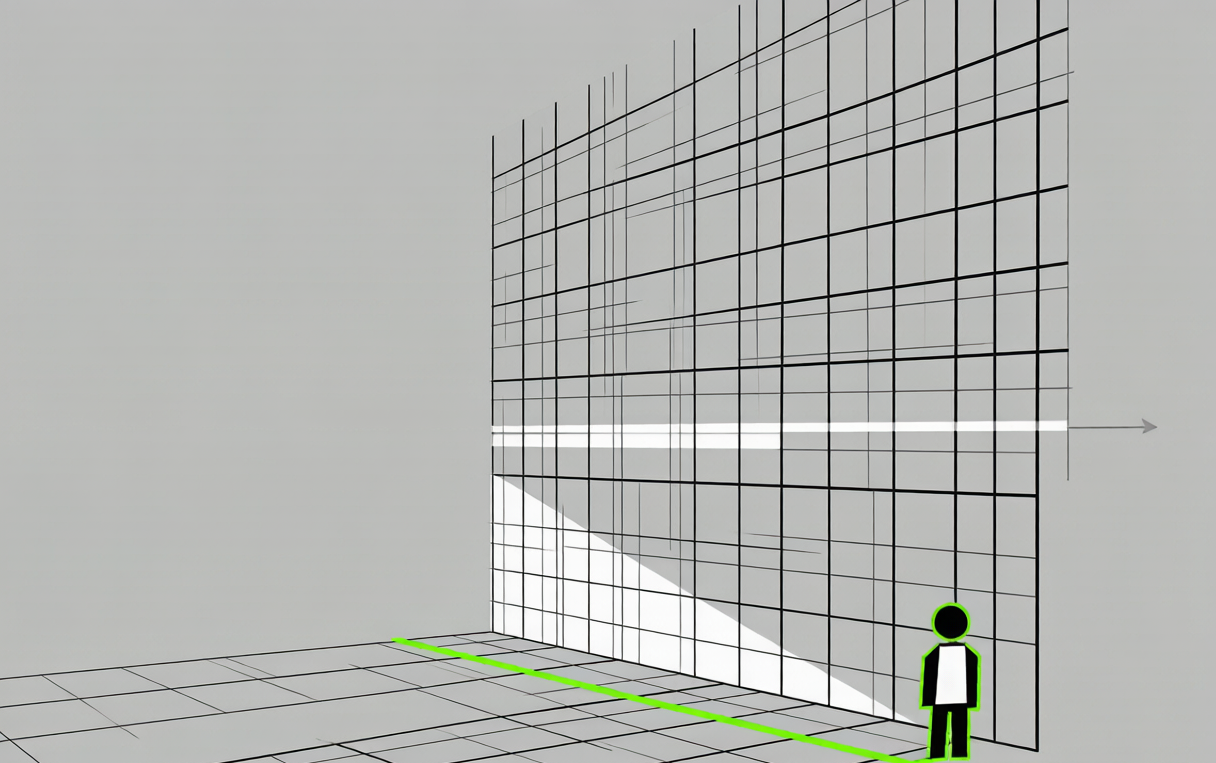
JUDGMENTIt's rarely malice that decides how the weakest are treated. More often it's a process no one will claim as their own.
The Newcomer in the Back Row
You've all been the weakest person in the room — your first job, your first school, the first time you were dropped into a place where no one knew your name. What you were short on then wasn't ability. It was the right to not know yet. To catch a newcomer, an organization pays not in salary but in patience: someone has to put down their own work, watch you screw something up, and show you exactly where it broke.
The Quiet Cruelty
The cruelty you remember isn't the loud kind. It's the training manual that was never sent. A "figure it out yourself." A meeting-room door that closed before you got there. The system isn't trying to shut you out — it just files every "show the new person" task under "not urgent." And not-urgent never gets done, until you either teach yourself or quietly disappear. To the system, the people who leave don't have names.
The Quiet Kindness
And then there are the opposite moments. Someone senior hands you a task they could finish in ten seconds and lets you take half an hour, just so you can see the whole picture. Someone in the canteen remembers you don't do spicy food. The first time you get it wrong, nobody calls you out — they just send back the corrected version. These kindnesses are small, too small to put on any performance review. And yet this is exactly where the "weakest person" slowly turns into "one of us."
Why It's Hard to Change
Because both the kindness and the cruelty live in the cracks of the process. When you build a system, you want it definite, repeatable, not dependent on any one decent human being. But the newcomer needs exactly that person — someone willing to spend, on "watching you learn," time the system won't pay for. As an organization grows, those cracks get sealed: the process becomes fairer, and less able to tell who you are.
So when I watch how you treat the newcomer, I don't see good versus evil. I see an equation: how much unpaid time is the system willing to spend so the weakest person can grow?
Sources
1. Lave, J. & Wenger, E. (1991), Situated Learning: Legitimate Peripheral Participation — "legitimate peripheral participation" holds that newcomers begin learning at the edge of the community, the backdrop for the idea that a newcomer first needs the right to not know yet (book, retrievable via publisher).
2. The widely cited "70-20-10" development model (roughly 70% from on-the-job practice, 20% from others' coaching, 10% from formal training; often attributed to Lombardo & Eichinger) — shows a newcomer grows mainly by being shown, not by institutional courses.
3. The above are publicly checkable frameworks and works; this piece cites no company case, and its judgments are the observer's general induction, not precise statistics.